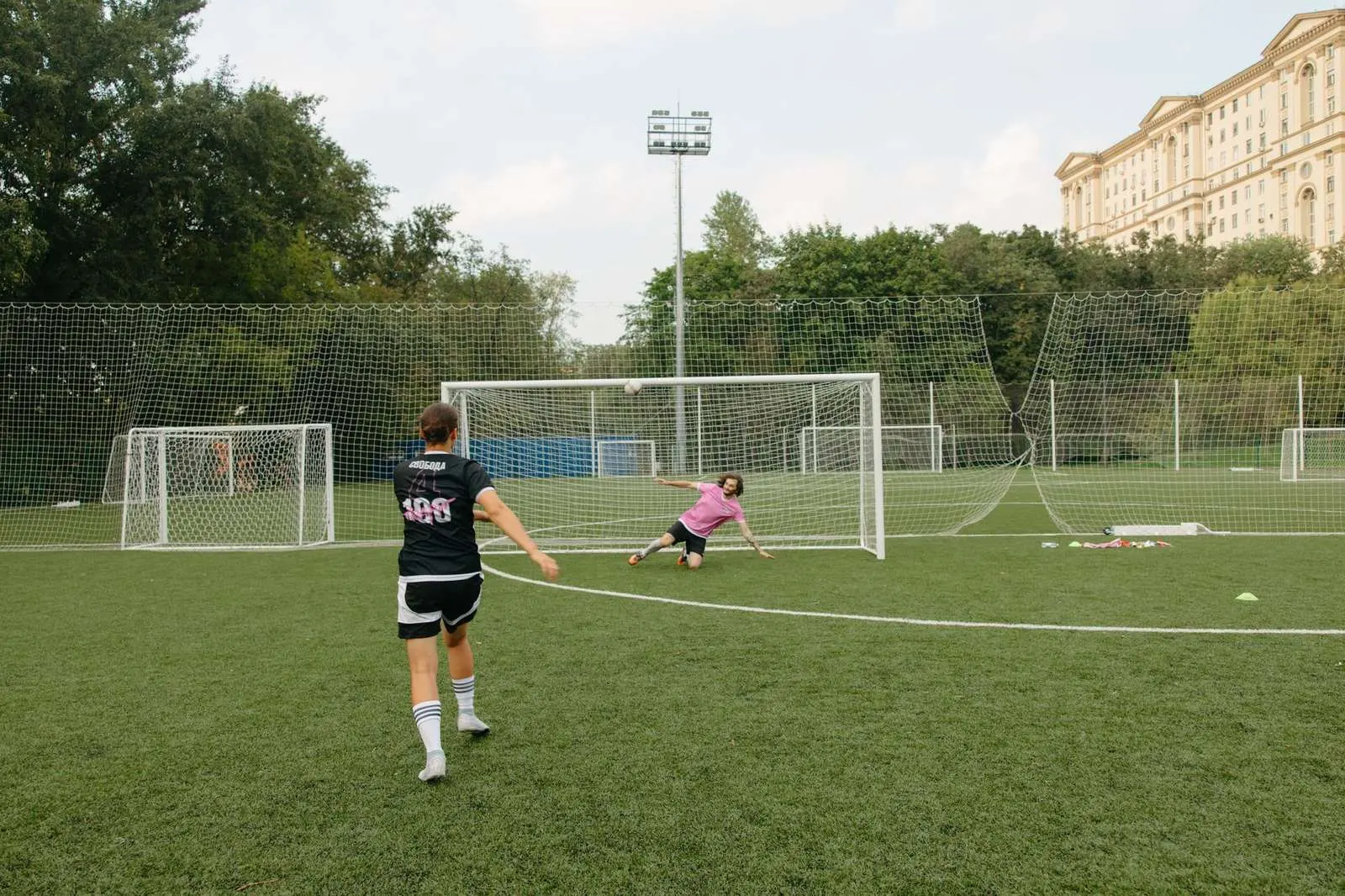

Confused about why a striker keeps vanishing from the penalty box? False 9 explained: it is a lone centre forward who drops into midfield to drag defenders out of shape and open space for teammates.
This role sits within the wider map of football player positions, from goalkeepers to wingers.
| Item | Value |
|---|---|
| Hungary v England at Wembley (1953) | Hungary won 6-3 |
| Nándor Hidegkuti’s record for Hungary | 69 appearances, 39 goals |
| Matthias Sindelar’s record in the Austria side | 26 goals in 43 games |
| Francesco Totti’s European Golden Boot season | 26 goals in 2006/07 |
| Barcelona’s haul in Pep Guardiola’s time in charge | 14 trophies |
These figures come from Wikipedia’s Hidegkuti profile and Breaking The Lines. Records and totals can be revised, so check the sources before you rely on them.
What a false 9 does on the pitch
A false 9 is a centre forward who tends to drop deep and join the midfield in possession instead of lurking around the box, according to Breaking The Lines. The player is usually the only forward in a 4-3-3 or in a variation such as a 4-1-4-1.
The point is to hand defenders a dilemma. Either a centre back follows the striker out of the back line and leaves a gap, or nobody follows and the midfield gains an extra body, as the same source explains.
In practice the role tends to show up in three ways, and a second Breaking The Lines piece notes that the hesitation it causes opens lanes for wingers and attacking midfielders:
- The striker receives the ball between the lines rather than on the last defender’s shoulder.
- The striker links play and creates, instead of waiting for crosses.
- Teammates run into the space the striker vacated.
Where the false 9 came from
For much of football’s early history, formations were rigid. Systems like the 2-3-5 and the WM formation gave players clear zones and responsibilities, as Kitcyclopedia describes.
Some accounts trace the idea to the late 1890s, when Corinthians’ G.O. Smith is said to have preferred supplying his wingers with through balls over staying as high up the pitch as possible, according to Kitcyclopedia. Treat that as a claim from one account rather than settled history.
Breaking The Lines credits Austria coach Hugo Meisl with picking playmaking forward Matthias Sindelar over a more traditional physical number 9, Josef Uridil. The same piece credits Sindelar with 26 goals in 43 games.
The best-known early case is Nándor Hidegkuti. Wikipedia notes that in the 1950s most international sides still used the WM formation, where the centre half marked whoever wore the number 9 shirt. When that defender tried to mark Hidegkuti, he was drawn out of position and the rest of Hungary’s attack could use the space.
The showpiece came in 1953, when Hungary beat England 6-3 at Wembley and Hidegkuti scored a hat-trick, per Wikipedia. That page adds that his position has only retroactively been compared to the modern false 9. Breaking The Lines says England’s centre half admitted afterwards that he had no idea how to defend him.
At club level, Wikipedia says Hidegkuti pioneered the deep-lying centre-forward position at MTK with Péter Palotás and coach Márton Bukovi. West Germany’s manager Sepp Herberger saw him as Hungary’s most important player and changed his tactics for the 1954 World Cup final to stop him.

Famous false 9 examples
In the 1970s, Johan Cruyff became the face of Total Football, a system that rejected fixed positions in favour of constant movement and interchange, says Kitcyclopedia. The same piece argues that Cruyff did not invent the false nine but made it unavoidable.
Francesco Totti gave the role its modern revival. An injury crisis left Roma manager Luciano Spalletti without a fit centre forward in January 2006, so he used Totti up front, and Totti won the European Golden Boot in 2006/07 with 26 goals, according to Breaking The Lines.
His job barely changed. The same source says he kept playing much like a number 10, only with no centre forward ahead of him.
Lionel Messi took the idea mainstream at Barcelona under Pep Guardiola. Kitcyclopedia says moving Messi centrally, but not as a traditional striker, fundamentally altered how opponents defended Barcelona. Breaking The Lines adds that his deeper positioning allowed Pedro and David Villa to drive into central zones.
Guardiola’s Barcelona won 14 trophies in his time in charge, according to Breaking The Lines. One role does not explain a haul like that, but it was part of the picture.
Other names tied to the role in this piece and its companion include:
- Cesc Fàbregas for Spain.
- Roberto Firmino under Klopp.
- Kai Havertz.
What makes a good false 9, and where does it struggle?
The role is not for every striker. Breaking The Lines lists the qualities a player needs:
- Sharp vision and passing under pressure.
- The patience to avoid forcing play.
- Spatial awareness to drag defenders out of formation.
- The ability to receive and turn in crowded areas.
The same source says scoring becomes secondary, because the player’s value lies in connecting phases and unlocking overloads. That is also where the approach can fail:
- Against deep defensive blocks, the space a false nine usually exploits disappears.
- When the midfield is congested, the extra man might add confusion rather than clarity.
- Some teams lack the technical quality to make the role effective.
- Coaches often return to classic strikers against physically dominant defences or when chasing a match.
Who has to move around a false 9?
When the striker drops, the work passes to others. In Breaking The Lines, the space is attacked by central midfielders bombing forward from deep and by wingers cutting inside from wide areas.
That leaves a question about cover behind the ball, and the guide on what does a defensive midfielder do looks at the holding job. Wingers who cut inside also leave room on the flanks, which is where the comparison of full back vs wing back becomes useful.
Why does it all work? Kitcyclopedia argues that defences rely on knowing who to mark and when to step out, and the false nine introduces doubt into each of those decisions.
Frequently asked questions
Is a false 9 just a striker who drops deep?
Show answer
Not quite. Dropping forwards are common alongside a partner in a front two, but a false 9 is the only centre forward, so the drop leaves nobody ahead of the midfield. Breaking The Lines draws that distinction.
Who was the first false 9?
Show answer
It depends on how strictly you define the role. Kitcyclopedia places the first true glimpse in the 1950s with Hungary, and Breaking The Lines says the 1953 Wembley match was regarded as the birth of the role. Earlier names such as G.O. Smith and Matthias Sindelar are sometimes cited too.
Did Lionel Messi play as a false 9?
Show answer
Yes, under Pep Guardiola at Barcelona. Kitcyclopedia says the idea had evolved quietly for decades before it exploded into global consciousness with him.
Why don’t all teams use a false 9?
Show answer
Few players have the blend of technical ability, intelligence and composure that the job demands, says Kitcyclopedia. The same source adds that centre backs grew more comfortable operating in space and teams built systems to handle positional fluidity.