Watching a match and wondering what does a centre back do? You’ll see a defender who guards the area in front of goal, blocking shots, tackling and making clearances, and who also starts attacks with passes.
This guide sits inside the wider overview of football player positions, so you can see where central defenders fit on the pitch.
| Item | Value |
|---|---|
| Main defender categories | Four (centre-back, full-back, sweeper, wing-back) |
| Centre-backs in most modern teams | Two or three |
| Formations that use two centre-backs | 4-2-3-1, 4-3-3 and 4-4-2 |
| Thought origin of the back four | Brazil, after the 1950 World Cup final defeat to Uruguay |
| Goal-kick rule change | Ahead of the 2019/20 season |
These figures come from Wikipedia’s defender entry and the Coaches’ Voice explainer on the modern centre-back. Formations, rules and tactical trends can change, so check the sources before you rely on them.
What a centre-back does in defence
A centre-back defends the area directly in front of goal and tries to prevent opposing players, particularly centre-forwards, from scoring, as Wikipedia’s defender entry describes it. It is one of four main defender categories there, alongside full-backs, sweepers and wing-backs.
The everyday work comes down to a handful of actions:
- Blocking shots
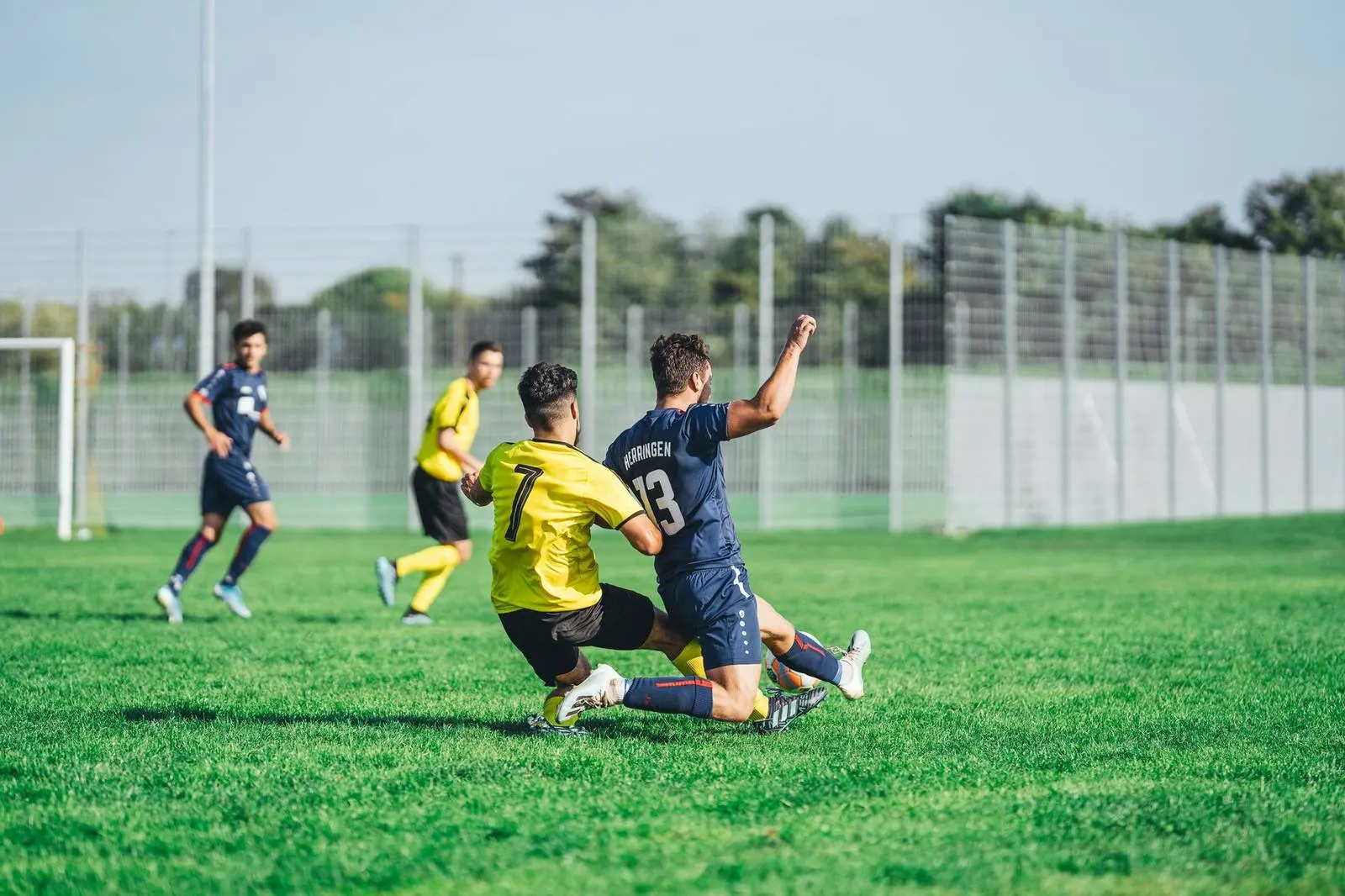
- Tackling
- Intercepting passes
- Contesting headers
- Marking forwards, so the opposing team is discouraged from passing to them
The Coaches’ Voice tactics explainer adds clearances and ground duels to that list. A clearance, in Wikipedia’s wording, is a long unaimed kick meant to move the ball as far as possible from the defender’s goal.
Off the ball, the centre-back is also the organiser of the back line. Coaches’ Voice lists organising the defensive line, communicating with teammates and leading at defensive set-pieces as part of the job.
How many centre-backs does a team play?
In the modern game, most teams use two or three centre-backs in front of the goalkeeper. The 4-2-3-1, 4-3-3 and 4-4-2 formations all use two, according to Wikipedia.
How those defenders share the work depends on the system. In a zonal defence each centre-back covers a specific area of the pitch, while in man-to-man marking each one tracks a particular opposition player, as Wikipedia explains.
Set pieces change the picture. When their team takes a corner or another set piece, centre-backs may move forward into the opponents’ penalty area, where heading ability helps if the ball arrives in the air. Other defenders or midfielders temporarily take over the centre-back positions, per the same entry.
How the centre-back role has changed
The term centre-back comes from the rise of the back four. Coaches’ Voice says a half-back dropping into defence turned the W-M line of three full-backs into a line of four, an idea thought to have started in Brazil after their 1950 World Cup final defeat to Uruguay.
Today’s centre-backs are far more involved when their team has the ball. They look to start attacks by building play and breaking through, around or over an opposing block or press with penetrative passes or dribbles, the same explainer notes.
The rules helped. The explainer says that, after the goal-kick change ahead of the 2019/20 season, centre-backs who are good on the ball can receive a pass from their goalkeeper inside their own penalty area.
Full-backs now attack as often as possible, which adds new demands. According to Coaches’ Voice, a modern centre-back needs to:
- Be agile enough to cover wide areas
- Delay counter-attacks while teammates recover into position
- Be bold enough to push up and support a high press
What makes a good centre-back?
No single quality defines a top central defender. These are the traits the sources keep returning to:
- Aerial strength: centre-backs are often tall and positioned for their ability to win duels in the air, Wikipedia notes.
- Passing range: they are generally expected to make long and pinpoint passes to teammates, or to clear long down the field, per the same entry.
- Anticipation: Coaches’ Voice says Rúben Dias reads the game very well and makes frequent interceptions thanks to his exceptional anticipation.
- Composure in duels: the same piece describes Dias as calm when engaging an opponent in an individual duel.
- Leadership: Virgil van Dijk is described there as a leader on the pitch who regularly communicates with and organises his teammates.
- Aggression: Sergio Ramos is praised for his one-on-one duels and his desire to jump out of the back line to intercept.
Few defenders score highly on every line. That is why coaches often build the central pairing around complementary strengths.
Partnerships and neighbouring roles
Many successful contemporary partnerships pair a more physical defender with one who is quicker, more comfortable in possession and capable of playing the ball out from the back. Wikipedia’s examples include Carles Puyol and Gerard Pique for Barcelona and Spain, and Diego Godín and José María Giménez with Atlético Madrid and Uruguay.
The sweeper, or libero, is a close relative. Its position is deemed more fluid than that of defenders who man-mark their designated opponents, according to Wikipedia.
Because a centre-back’s main task is to stop centre-forwards scoring, the guide on what does a striker do in football shows the other side of that duel.
Defenders play behind the midfielders, as the positions overview puts it. If you want to compare the back line with the midfield role ahead of it, the guide on what does a defensive midfielder do covers that job.
Frequently asked questions
Is a centre-back the same as a central defender?
Show answer
Yes. Central defender and centre-half are other names for the same job, and the modern centre-back role grew out of the older centre-half position, Wikipedia says.
Do centre-backs score goals?
Show answer
Not often. Under normal circumstances they are unlikely to score, but a corner or similar set piece gives them a chance to use their heading in the opponents’ box, per Wikipedia.
Do centre-backs have to be tall?
Show answer
Height helps with aerial duels, yet it is not the whole picture. Coaches’ Voice also stresses agility to cover wide areas and a good passing range.
What is a modern or ball-playing centre-back?
Show answer
It is a central defender with the same duties as a traditional one, but with more weight placed on what they do in possession, according to Coaches’ Voice.